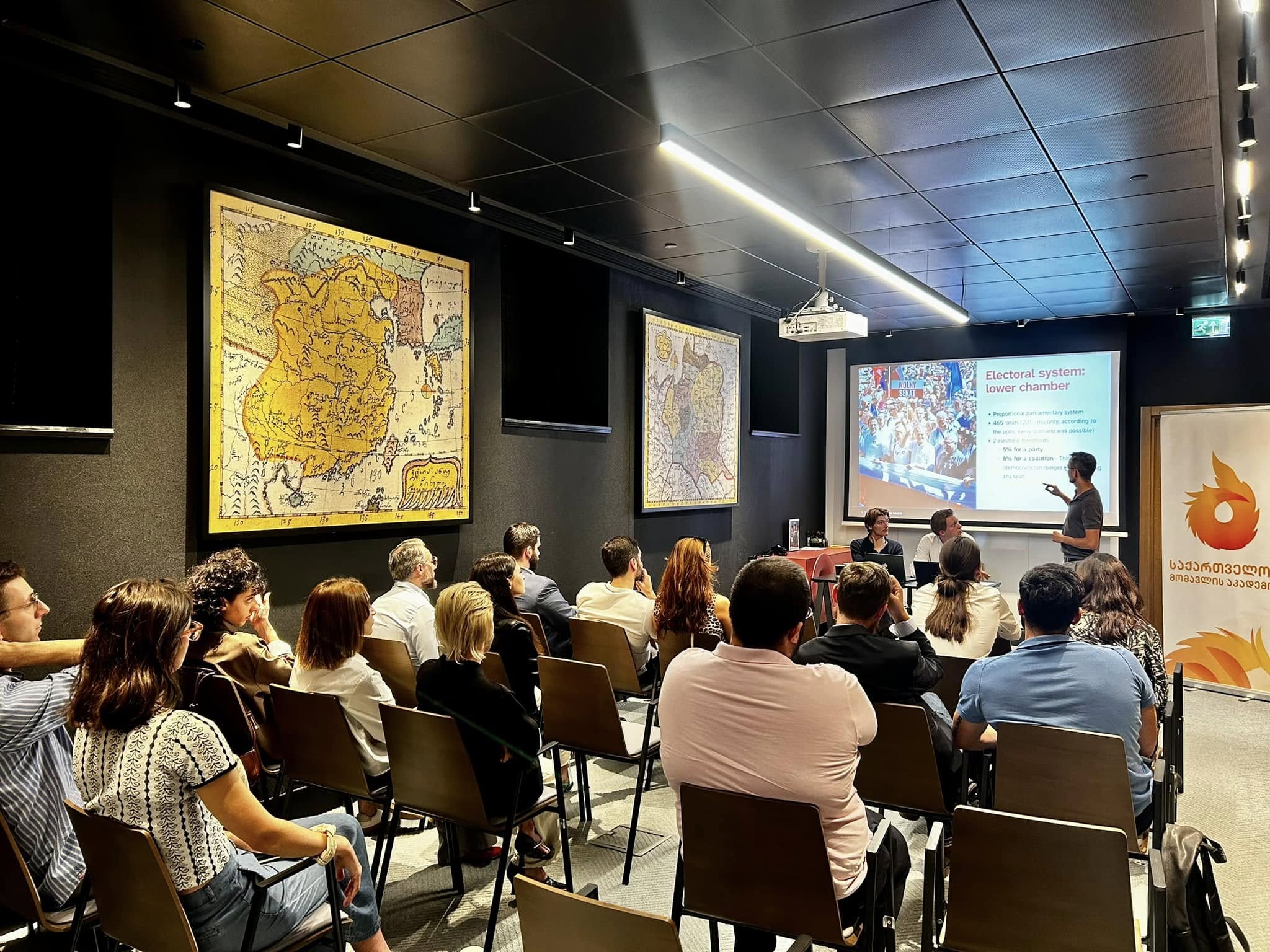

On 13–14 December, Georgia’s Future Academy observed the elections of the governing bodies of the Georgian Bar Association.
On 13 December, during the Association’s General Assembly, members of the Georgian Bar Association elected the members of the Vote Counting Commission through an online voting process. On 14 December, elections were held for the Chair of the Association, as well as for members of the Executive Council, the Ethics Commission, and the Audit Commission.
Georgia’s Future Academy’s observation aimed not only to assess the transparency and fairness of the electoral process but also to examine the use of modern technologies in elections and the potential risks associated with their implementation.
It should be noted that, overall, the Georgian Bar Association ensured the organization of the elections in a manner that provided equal conditions for all candidates on election day and upheld the transparency of the process. Although the Association's regulations did not provide clear answers to several important questions — including the scope of observers’ rights — observers encountered no obstacles in practice while conducting their monitoring activities. It is also commendable that the election process was recorded and live-streamed.
With regard to the use of technology, several important circumstances merit attention:
a) On 13 December, registered delegates were able to elect the members of the Vote Counting Commission electronically through an open vote. The process required sending a one-time code to the delegate’s mobile phone, after which delegates accessed a special portal by entering the code along with their personal or identification number. At the beginning of the process, some lawyers experienced difficulties receiving the SMS code, while others required technical assistance to complete the voting procedure.
While the introduction of electronic technologies in the elections by the Association is welcome, it is necessary for the Association to be better prepared in the future to address technical challenges related to the system in use, and at the same time to invest in raising users’ awareness and competence in using such technologies.
b) On 14 December, voting was conducted using Smartmatic voting machines. Unlike the parliamentary elections, the machines provided by the Central Election Commission were equipped with an additional cover, which offered comparatively better protection of ballot secrecy. Nevertheless, the marked circle on the ballot paper was still visible on the reverse side. In practice, ballot secrecy was preserved only by the fact that the number of marked circles on the ballot was significant, making it challenging to identify a specific voter’s choice. Of particular concern is that when inserting ballots into the scanner, the overwhelming majority of lawyers required assistance from technical staff.
The elections held on 13–14 December demonstrated that, in any type of election, it is essential to introduce technological solutions that are easy to use for the majority of voters and do not require additional effort or the involvement of technical personnel. For example, the use of appropriate frame envelopes that facilitate the insertion of ballots into scanners would significantly improve the process. At the same time, it is crucial to strengthen voters’ awareness and technological skills systematically.
Finally, although no cases of repeated voting or other similar forms of electoral fraud were identified during the Bar Association elections, this outcome was primarily the result of the Association’s political will, the integrity of the lawyers themselves, and the overall transparency of the process, rather than the effectiveness of the technological and procedural safeguards in place.
Such an approach does not constitute a sufficient guarantee against potential risks in future elections. If, in future electoral processes, the Central Election Commission and other responsible bodies fail to introduce additional safeguarding mechanisms to ensure ballot secrecy and the integrity of elections, similar violations to those observed during last year’s parliamentary elections may recur.
Similar News
Support our work
By supporting Georgia's Future Academy, you will empower the youth of Georgia and help build a modern, developed, and thriving nation.